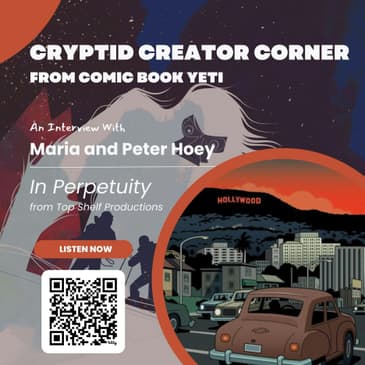
I think these 2 creators may be the first siblings we've had on the podcast, but more than that, they lived in DELCO for a time! I couldn't be happier to chat with Maria Hoey and Peter Hoey about In Perpetuity, their most recent graphic novel published by Top Shelf Productions. In Perpetuity is a retelling of the Orpheus myth set in a timeless Los Angeles with very strong classic noir vibes. I absolutely loved this (and not just because the main character is named Jim, I swear). This was such a fun chat, I loved learning about their approach to comics and art, and hearing about their influences. After listening, be sure to check out their website and more great comics at Coin-Op Books. In Perpetuity is out now, it's a great twist on this story, and absolutely gorgeous linework and colors.
From the publisher
In perpetuity, the Afterlife is just as the ancient Greeks imagined: an endless twilight where time stands still and shades have nowhere to go. For Jim, that means long shifts at a gas station, with only crossword puzzles and cigarettes to break the tedium.
One day, two criminal shades from Jim’s past show up at the gas station and his existence takes a dangerous turn. They’ve tracked him down for something he didn’t know he had: the ability to cross back into the living world. It’s a rare gift, and they intend to exploit it.
Just as Jim crosses back into sunny California, he meets Olivia dying on an Echo Park sidewalk… pulling her back from the edge of death and striking a connection that will run deeper than either can imagine.
Jim weaves back and forth between the Afterlife and Los Angeles, but the more he tries to distance himself and Olivia from the criminals’ plot, the deeper they're pulled in. What follows is a web of deceit and murder that reaches across A.L. and L.A., and ultimately to Hades himself.
With a heady blend of film noir and Greek mythology, In Perpetuity reveals both the human capacity for self-deception and the endurance of love.
Our episode sponsors
Don't miss Eisner and Harvey award winning comics creator Michael Avon Oeming's newest crowdfunding project After The Realm. With over 300 pages of material and 22 new pages of story, this graphic novel collects issues 1-5 of this realm trotting dystopian fantasy adventure that follows young ranger Oona Lightfoot's travels and travails trying to find her best friend as the nine realms are torn asunder.
Arkenforge
Play TTRPG games? Make sure to check out our partner Arkenforge. They have everything you need to make your TTRPG more fun and immersive, allowing you to build, play, and export animated maps including in person fog of war capability that let’s your players interact with maps as the adventure unfolds while you, the DM get the full picture. Use the discount code YETI5 to get $5 off your order.
Learn more about your ad choices. Visit megaphone.fm/adchoices
[00:00:00] Your ears do not deceive you. You've just entered the Cryptid Creator Corner brought to you by your friends at Comic Book Yeti. So without further ado, let's get on to the interview. Hey Comics Fam!
[00:00:14] There's a realm-trodding dystopian fantasy adventure that cleverly explores Norse mythology sound up your alley? It sure does mine, so I was excited to see one of my favorite comic creators Eisner and Harvey award-winning
[00:00:26] Michael Avon Oming is launching a new Kickstarter project collecting issues one through five of his creator-owned series After the Realm in July. I just got a chance to get an early peek and it's fantastic with over 300 pages of material including 22 new pages of story
[00:00:42] It follows a young rebellious ranger named Una Lightfoot trying to find her best friend as the tale of friendship and destiny unfolds The nine realms are torn asunder with Loki up to his usual trouble-making self, of course
[00:00:54] It should come as no surprise at this point that the cast of unusual characters Michael created in the book includes some anthropomorphic animals
[00:01:02] But I can't say I've ever seen them riding roughshod across the land in many tanks a la Mad Max Fury Road before so I'm so here for it
[00:01:10] Perky slightly beautifully unhinged and completely engrossing the immediate analogs to me where the legend of Zelda meets the mighty Thor with Norse underpinnings for perspective Michael is handling both the riding and the artwork duties with Takisoma on colors and Sean Lee lettering the project
[00:01:25] Head on over to Kickstarter and make sure you back this cuz it's epic Y'all Jimmy the chaos goblin strikes again I should have known better than a mention that was working on my DC universe meets Ravenloft hybrid D&D campaign on social media
[00:01:47] My bad. He goes and tags a bunch of comics creators We know and now I have to get it in gear and whip this campaign into shape so we could start playing Another friend chimes in are you gonna make maps?
[00:01:58] It's fair to say it's been a while since I put something together So I guess Question mark it was then that I discovered archon forge if you don't know who our can forge is they have everything you need to make Your TT RPG more fun and immersive
[00:02:12] Allowing you to build play and export animated maps including in-person fog of war capability But let your players interact with maps as the adventure unfolds while you the DM get the full picture
[00:02:25] Now I'm set to easily build high res animated maps saving myself precious time and significantly adding nuance to our campaign That's a win every day in my book check them out at archon forge.com And use the discount code yeti five to get five dollars off
[00:02:40] I'll drop a link in the show notes for you and big thanks to archon forge for partnering with our show I think I'm gonna make Jimmy play a goblin warlock just to get even Hello and welcome to comic book yeti's cryptid creator corner podcast
[00:02:53] I'm one of your hosts Jimmy Gasparo and I have two creators on the podcast with me today and We've just discovered a connection that I my research didn't lead me to I'm very excited about but This is a brother and sister
[00:03:12] They work together for a number of years to create some fantastic comics like And I am very excited to talk about their newest one through Top Shelf It's called in perpetuity. It's a bit of a take on a Greek myth with a Really interesting noir idea
[00:03:32] Kind of a smuggling operation which we're going to get into and talk about I blew through it today Absolutely loved that it's out right now put a link in the show notes so you can get it but
[00:03:44] These the two of them they've been nominated some of their comics for an Eisner Award in 2020 they were nominated for an Eisner Award in 2019 they have just a bevy of Awards and nominations for some of the comics they've created and if you go on their website
[00:04:03] They even have one about Chuck Berry's revenge that I gotta try and sneak in and ask him about cuz um It looks like it has a little bit of a back to the future not as well
[00:04:10] So maybe we'll maybe we'll touch on that but please please without further ado welcome to the podcast Maria Hoy and Peter Hoy Maria Peter. Thank you so much for coming on to talk to me about in perpetuity. Thank you so much
[00:04:26] So the book just I think it just came out in April through Top Shelf I Really, I mean I didn't have you know I've the the digital version of it
[00:04:35] But I really like the format of it first of all and this is kind of a take on Greek mythology where we see a mirror of LA and Al the afterlife and your main character Jim great name is kind of working it working at a gas station and
[00:04:56] It's that the Greek idea of the afterlife where Everything's kind of gray muted. There's no need to like eat. There's no real like earthly pleasures You're just kind of wondering about and he gets involved with some characters from when he was alive
[00:05:12] And that kind of sets into motion the whole the premise of the book but You know Peter you wait before we started recording you were talking about it But can you just kind of like set the stage for the listeners about in perpetuity? Sure
[00:05:29] The deal with in perpetuity is it plays off the Greek mythology idea of the afterlife which is Basically, nothing this when you die you're a shade and you're in the in the underworld and you're there and nothing happens really There's no sensual pleasures anymore
[00:05:47] Yeah, there's no sex. There's no drinking or food or anything like that. You just wander around and so You know it I was very much interested in the idea of letting you in the myth Greek mythology ideas of Orpheus and Eurydice and the idea that there's this
[00:06:06] Afterworld that sometimes people from the living world can go into and that there's this kind of like Split between the living world and the afterlife. So in our case it was LA Which is Los Angeles and AL which is the afterlife
[00:06:21] And this guy Jim is working in a gas station in the afterlife uh Because it's kind of like LA but everyone's dead and rather than just wandering around because it's uh The afterlife of LA they drive around and so he works in a gas station And one day
[00:06:40] Some of the people who put him into the afterlife show up at the gas station for a tank of gas and realize Hey, you're here too They being criminals Basically extort him into a scheme Uh a smuggling scheme that works
[00:06:57] Uh across the afterlife to the living world and he gets dragged into it. Uh, and that's where the story unfolds Yeah, I mean I um I I like the the idea that The the folks in the afterlife
[00:07:13] Didn't quite recall maybe like the moment of their death or a little bit before uh And it's dropped when he meets up with like eddie and raymond. It's it's dropped so casually
[00:07:26] Yeah as to like what happened to jim almost so that jim doesn't really get a chance to You know react to it. I it seems to be part of
[00:07:36] um, I mean the characterization because it it almost seemed like his even his emotional responses were muted in the afterlife Yeah Yeah, it's true. I mean the rules that we set up for how the afterlife works You know about your life that you had when you're alive
[00:07:54] But the moments up to and including your death are kind of a blank. You're kind of you don't remember them very well He knows what his life was about he knows who he was and he knows that he's dead now But he didn't really know who killed him
[00:08:09] Exactly because it happened so suddenly and that kind of memory is just kind of like You're kind of like an estate of shock and you don't know what's going on but uh The guys who killed him they know that that they killed them and they're dead too now
[00:08:23] But they figured out uh that they can use jim because jim has a talent. He's not even quite aware that he has which is that he Can cross back over into the living world and that that sets up the idea of smuggling because
[00:08:39] Uh the thing that the people who are in the afterlife want more than anything else is to go back into the living world At least for a little while and they can bring stuff back into the living world from the afterlife
[00:08:53] One of which is money. Yeah, they still have money in the afterlife Uh, and they're able to smuggle that back cross. That's one of the things they smuggle Yeah Maria I mean in terms of this do you both share like a love of either like greek mythology or
[00:09:11] Noirs or like what are the different influences in terms of how the two of you create together? Uh, well, I think you know growing up together. We sort of consumed similar movies tv books Kind of like sensibility and so yet noir is definitely
[00:09:30] A love that both of us have and it's kind of like such a natural horror graphic novel this this just It it makes such a pleasurable experience for someone to dive into and it's It just it all clicked the la and the al is just a perfect
[00:09:51] Perfect story setting Yeah, I thought it was interesting in terms of you know when it's um, I'm not sure You know how the your collaboration exactly, you know works when you Who added like what details to it?
[00:10:06] But I thought it was very interesting when you're adapting or not a straight adaptation but even being influenced by something like the myth of orpheus And you're using la as as you're setting and and the afterlife kind of mirroring that
[00:10:22] You know the things that you decide to include because there was um You know the cars being one of it. There's always like traffic like even in the afterlife. They can't get away from that you know, but but Jim it seemed he died in 95, but
[00:10:40] The afterlife has uh, you know An old-fashioned feel like it it was difficult to discern exactly the the time period at times But he's out there pumping the gas and checking the oil and squeegeeing which seems
[00:10:53] I mean other than new jersey. I don't know if any state's doing that anymore but What went into kind of deciding? How you were going to not just set up the rules of the afterlife, but the actual look of it
[00:11:08] Yeah, I think you're right jimmy about the the sort of timelessness of it We wanted to make it uh, not a specific time period But a sort of like the past but not any particular past. It's not like a 1940s or 30s past
[00:11:24] Or a 1960s past, but it's kind of older but kind of undefined And because it's the afterlife and it has rules to it and it's because it's essentially Los angeles afterlife um People have jobs since everyone
[00:11:41] Rather than wanders around they drive around all the time you need gas stations and you need people to work at them And because people have nothing to do Uh, they do crossword puzzles all day
[00:11:52] So you have like newspapers and you have bars and stuff, but they don't serve liquor If they just give you an empty glass and there's like entertainment, but it's really bad
[00:12:03] You know and there's movie theaters films are all like cut up and they don't really make sense anymore There's no restaurants or anything But there's apartments and there's used bookstores and there's dry cleaners
[00:12:15] But there's nothing that really like is much fun. You just kind of like, you know It's just like some kind of like drag area that just goes on and on, you know, kind of like LA, you know
[00:12:27] And we figured like that would be cool. Yeah, they're just like you're just stuck in traffic all day Like that's you that's your world and you know So yeah, that's we kind of like built it up from there
[00:12:39] And the sea is dead the air is dead. Yeah, people are dead The music's dead. It's just Dullesville Yeah, total Dullesville Yeah, the there's always like a gray. I mean, I guess LA works for that because if you're Yeah, your mirror of LA is
[00:12:58] It's always kind of gray and smoggy that you know that that kind of fits. Um, also everyone in the afterlife seems to smoke Oh, yeah It kills time. Yeah kills time and you can't get cancer. You're already dead
[00:13:12] You know, I was thinking of it kind of like the way that old show drag net looked where it was just like Everyone's just kind of humdrum and they're just kind of going through their life But it goes on forever. So, you know, it's like that. Yeah
[00:13:27] Well, I I did there were times with what I thought uh with jim that Um, you know, I don't know. There was almost like in the opening of it There was like a certain piece to it like he seemed like he liked his job
[00:13:39] Even though there was not supposed to be any earthly pleasure. He liked his coveralls and oh, yeah He's so well enough. Yeah, his life is pointless and forever. But well, it's not his life It's his afterlife, but it he's not unhappy with it. Yeah, everyone could
[00:13:53] That just is yeah, it is. Yeah exactly. Yeah, I mean, I thought that was uh You know interesting in terms of that setup because
[00:14:03] When you get into the noir elements and kind of the trouble that jim finds himself in and you really kind of start to dig into some of the themes of it, um
[00:14:14] You know that is your afterlife then and you have a knowledge of that when jim gets to kind of go back Everything on earth is then
[00:14:22] You know heightened you get these little glimpses like when he's out in the sun and when he's doing these these types of things that like they everything
[00:14:31] Seems to mean a little bit more to jim and you can really tell that difference in terms of how he's depicted and In the illustration too We it was important for us to switch because the the the chapters where jim's in the the afterlife
[00:14:49] Are very gray and subdued and everyone's behavior is subdued as well But when he goes into the back to the real life into los angeles everything all of a sudden the sky is blue
[00:15:01] And it's bright and everyone's loud and things are happening and it's like all of a sudden It's like exciting again, which is you can tell like the shades What they want more than anything is to be able to go back into the living world
[00:15:14] And that's what sets up the smuggling like there's there's wants on both sides That the dead people want to go back to the living world and the living people want the stuff that the dead people have
[00:15:25] Which is they still have money. Yeah, that's the funny thing and in the afterlife They still have cash, you know, but it doesn't mean anything so they have loads of it So they can like smuggle it across so And you know and there's also smuggling of
[00:15:40] Shades into the living world that right as we get into the story. Yeah Well, I also like the added Elements in terms of when you get into the like the nitty gritty of like the smuggling operation
[00:15:50] And you kind of set it up and set up how jim's going to be used that instantly you get a sense from the The probation or parole officer in it that they're already working on a way to
[00:16:05] You know commoditize it right to monetize it like it's not just that we want to go and we have money and we can live like There's there's a mixing in an la and a hollywood that like wow, they've even found a way to try and monetize the afterlife
[00:16:20] The cops are corrupt on both ends There's dead cops and there's living cops and they work together And they figured out how to work this corruption Even though the boss in the afterlife is hades. Yeah, he's the god of the underworld
[00:16:35] But there's cops in the underworld who kind of enforce the rules One of which is you can't have seances or anything that could in any way Hold dead people back into the living world or allow communication between the living and the dead world
[00:16:49] But the cops on both sides realize, you know, we can turn some profit from this Yeah, the corruption exists. Yeah. Yeah, I felt the rules were very well set up and The smuggling operation was very You know structurally sound without being like
[00:17:09] There are very few panels that feel like exposition heavy even though you're really setting up kind of like a complicated It's complicated. Yeah. Yeah, but you can't read out too many rules because it slows the story down
[00:17:22] You know, you have to keep the story has to keep moving all the time But you understand that the corruption goes With the living and the dead, you know, and the one thing that the god of the underworld can't stand is
[00:17:35] The corruption of his like employees, you know, this is off because he's he's the king. Yeah, he's the god of the underworld in terms of Like setting up the format of the book and the paneling because I really liked a lot of the like the diagonal
[00:17:51] Paneling scheme. I kind of like the flow of it Um, how I mean is that maria? Is that that you who does that like how is that set up in terms of that? That aspect of it. So pete does that part. Do you want to tell?
[00:18:05] Talk about that pete Yeah The initial like sketching out of the the pages jimmy is um, Yeah, I just sketch it out in pencil at first But I it was important to me that we have like a really Clear difference between the living world and the afterlife world
[00:18:23] And one of the ways was with the color to make the afterlife very subdued and kind of grayed out in the living world kind of You know natural and alive But the other way was with the panels to make the the panels in one world like very
[00:18:38] straight across and horizontal and then the The you know, the other world the underworld like diagonal like it's kind of crooked Like the way in Batman when they would show the bad guys the camera would always be tilted on an angle like
[00:18:51] It kind of is a nice clue to let you know Which part of the world that you're in Yeah, I I felt like that was a really nice touch in terms of Having that uh, you know having that separation Um, yeah, it keeps us straight for the reader
[00:19:09] You know important because it moves the story moves back and forth between the living world and the afterlife You know A dozen or two times over the course of the book So it's really important for us that people don't get lost
[00:19:22] they always kind of know where they are and um And I think that made it like more interesting because you can see the jump when it would go from one world to the other Uh, it kind of made it more exciting. Yeah subtle little clues whether Yep, yeah
[00:19:40] Marie I wanted to ask you in terms of the you know the work with In perpetuity When you have, you know are developing a story like this Um, how do you kind of like like get into it to
[00:19:58] So for for this book Pete wrote the story. I mean he it's In perpetuity is his story and then we start building the pages together. That's really how I came in So after the pencils are done, we start um over the next eight and nine months
[00:20:17] making the art finessing the type Story does go through rewrites as we you know, we write it out first in prose like I wrote most of this in prose And then we sketch it out and put the type in on the pages, but it gets rewritten like
[00:20:34] Dramatically from there when it goes from like prose into the comic form most of the Uh descriptive stuff drops out, you know And when then we rewrite a lot of the dialogue because you start once it It's it's one thing when you see it written in prose
[00:20:50] But when you see it on the page on the panels and stuff and in frames it looks different And so we end up like rewriting a lot of it and sharpening it and shifting focus from one character to another. So it goes through um
[00:21:05] Refining, you know from the beginning to the end And when you are going through that like editorial that editing process like are you each taking a pass at it or kind of how do you Yeah back and forth. Yeah. Oh, yeah
[00:21:20] And then maybe another pass so maybe four passes First spread Yeah, it is this how you've always worked in terms of like the other anthologies like coin-op and other things that you've done Yeah, pretty much. Yeah it
[00:21:35] I guess um with some of the other stuff and then within perpetuity like Because that's kind of an I think with some of the creators I've talked to before I think that's kind of a unique way to do it to write something out in prose
[00:21:50] Because you're all you're all you're essentially almost adapting like your own work Yeah, exactly How did that, you know develop? Did you have an idea for a story and it didn't quite work as prose and you wanted to try it into comics For the earlier stuff
[00:22:07] Are for our shorter form comics those we don't write out beforehand We just kind of like sketch them out and then we write them at the same time And we kind of pass it back and forth because it's only like four pages eight pages 12 pages. It's much easier
[00:22:23] It's much smaller the story But when you're doing like a novel length book When you have multiple chapters and multiple characters, it's easier For us to keep it straight to write it all out in prose as just like a
[00:22:39] Story and then break it down into chapters and then pages and then frames and then Sketch it out from there using the prose as a guide And then you just change all the prose to fit Into the to the drawing part because they have to
[00:22:57] The straight prose doesn't work on its own It has to be with the drawings and so you have to like kind of make them work together And so you end up like shaving down the prose and rewriting it and then sometimes redrawing frames to to to fit
[00:23:12] You know, or you know, you'll have ideas as you're doing it like oh wait Yeah, maybe this character should be a little more important And you end up redrawing a few pages and you know It's there's like a kind of back and forth in that middle period
[00:23:25] Uh from when we're first sketching it out to when we're doing the final drawings that it that it really shifts a lot at that point Oh, wow, that's uh, yeah, that's interesting. I mean, I mean it makes sense. It just um
[00:23:37] I think it's somewhat of a maybe unique way to to handle uh To create a longer form graphic novel, but I mean it totally makes sense Yeah, it's also just made sense to keep everything straight that way
[00:23:49] But you know people are like, oh you you write it all out So it's all just like what you write is like no Totally like all the descriptive stuff in the prose goes away as soon as you do the drawings It's like the drawings
[00:24:01] Explain that for you. You don't need words to explain it But dialogue and dialogue shifts too because you you know once you put it things look different when you have it written down and
[00:24:12] Dialogue written in prose in a straight story then when you put it into frames all of a sudden the dialogue's like wait No, it doesn't really work. You got to rewrite it. Yeah, but it creates the beat
[00:24:22] Yeah, it creates the backbone for the whole story and then it It's the drumbeat throughout the whole rhythm the rhythm of the story is really important And that's where we that's where the prose comes in
[00:24:33] Yeah, the prose establishes the meter of the whole thing from beginning to end Oh, wow That's interesting. I mean I know some I've heard You know other writers talk about like doing a beat sheet or something along those lines
[00:24:48] But to say that like the prose kind of creates that rhythm I mean it certainly makes sense because there's such a it's so well paced for I mean, I think it's over 200 pages. Isn't it in in permittivity in particular and it's it's it's it's very well paced
[00:25:04] It doesn't love the pacing Super important for us. I mean it has to have like a rhythm and within the rhythm There's ups and downs. There's little peaks and valleys But it has to maintain like a a sort of rhythm to it and there can't be dead patches
[00:25:19] There can't be stutters. There has to be like a continuity to it Like like music is you know, and so that yeah, that's really important to us and because there's two of us just Collaborating. Yeah, there's a lot of shorthand
[00:25:35] There's a lot under, you know, we're just working together a lot is understood Some people will write scripts and it's heavily descriptive. We don't really need that All right, let's take a quick break
[00:25:48] Hey comics fam itty comic book publisher band of bars just got a level up and announced it is now a cooperative This heralds a new era for them including a partnership with doll's stories
[00:26:00] And they added several new members to the ownership group Marcus Jimenez is now chief operating officer Brent Fisher takes on the role of chief diversity officer And joey galvez is introduced as head of Kickstarter ops and social media manager
[00:26:14] Which is sure to increase their capabilities overall as a publisher And it further promotes their mission statement of advancing representation Inclusion and diversity in the media They also established a new board of directors to help chart the new path of their journey
[00:26:29] With new projects in the works like Alaska by dropping in june Unbroken soon launching on Kickstarter and pond coming up with thoughtless Stay tuned to this space for more exciting news from the growing bards family Let's get back to the show Growing up together
[00:26:48] Like was that easy to get into because you you know your siblings and kind of have that history or once you actually started working together Did it take a while to Kind of develop that shorthand Maybe six months. Maybe six months Yeah, that's pretty fast
[00:27:07] Now it's the it's the sibling thing we grew up together You know So we have a shorthand we can work together really easily. We don't have to like Explain everything right and things can
[00:27:22] Explode out of that, you know things you might not have thought of or be afraid to bounce it off someone else He don't really have that when your siblings right When did the two of you first start? You know for our listeners that might not be familiar
[00:27:38] When did the two you first start like working together in terms of like any type of writing not just comics? Well, we we were our day job jimmy's we work as illustrators and we started working together in 1997
[00:27:52] Um maria had just gotten out of art school and I was already working as an illustrator and I was looking For an assistant or a coworker um, and so we started working together then we were both living in dc then and um
[00:28:09] I had just started doing some comic stuff for um A fenographics anthology called blad that was being published at the time Yeah, that money both shamp. He had called me up out of the blue
[00:28:22] And asked me if he had seen some of my illustrations and said oh there your stuff looks kind of like comics Would you ever think of doing any and I was a big comics reader at the time? but I hadn't ever
[00:28:34] Had never occurred to me to do comics and so he encouraged me to do some stuff for blab And that was right around the time maria started working with me. And so we just began working together Yeah
[00:28:50] We started off doing very short comics like you have four pages six pages Like the first one took like six months. Yeah, it took a long time. It was just like oh my god So hard And then I mean so um
[00:29:08] You know, we started self publishing our own and those you know, we had to we had to fill out a lot more pages than four Yeah, we're six. We had to get we had to get faster
[00:29:18] And I mean and coin op is up to like what nine eight nine Wow, um, yeah, we were just about to start in on number 10. Yeah It so uh Peter already said that he had been a comics reader maria. How about you? Had you ever?
[00:29:35] Oh, yeah, comic before well. No, I read him. I mean I read okay We we got the inquirer every day at home and so I read the comics every day But in turn and then you know art books in art school
[00:29:48] But not never marble. I never went to a comic book store every week. That was not I don't really know that girls did that too back then where we grew up There was really no comics culture
[00:30:02] I didn't really see that if you know, there was the the paper and then there was like art books And I didn't really see Comics that I would enjoy as an adult really until I was an adult
[00:30:16] Yeah, I mean I think that makes sense for that that time period. Um When you first started maria like Creating them. What do you think was the biggest? I guess like adaptation in terms of going to art school and then putting comics together
[00:30:33] Well, I think that well, there was no preconceived idea what a comic could be You know, we're doing four pages of art And telling a goofy story a weird story, you know, it was we were
[00:30:46] It wasn't oh it looks like this person or that person. It was we were making our own thing. So actually it was very free Yeah, that sounds great. Yeah Oh, what do you think for both of you? Um
[00:31:04] In terms of the comics that you make now like through point-op nine in perpetuity and You know some of the other comics that you've created What do you think are the biggest influences on the two of you? You know um
[00:31:23] Probably not other comics. Um, I think like for for myself, you know I'm a big music listener. So music is a big thing for me. I really like I like cinema a lot
[00:31:37] I like movies. Yeah, those are big influences. I read a lot. I'm like a huge read. I read everything um So those things are like those things are Really influential on me on just like the kinds of stories I like and the kinds of like images I like
[00:31:54] And I think American culture. I think our work is very American in a In the best way. Yes Uh, and and it dives into that and I Think back we both grew up with older parents sort of um
[00:32:12] A little bit of out of time always and so I think Our work maybe touches back on different eras because um, those were what was around in our house different kind of music uh
[00:32:28] Movies, you know tv was always on but it was like black and white movies remember growing up It was like that was what you could see all the time. So right No, I think that's very interesting like
[00:32:41] Having older parents and feeling like you were out of time or like out of sync to what you were like Or you were like you were driving parallel like you were into cool stuff that was now But then you were also aware of like Oh, uh
[00:32:55] Like they're listening to big band music in the kitchen, you know There was lots of different worlds playing at once. Yeah And and one and one didn't get weighed heavier than the other right Yeah, no, I I I I get that. I mean I was
[00:33:12] I mean i'm 45 now and um Uh, my both of my parents worked when I was you know first born so the first few years of my life I was watched, you know pretty exclusively by my grandmother
[00:33:25] And so and my grandfather. So I grew up and on tv it was always Westerns from the 50s because that's what my grandfather loved and my grandmother loved any type of musical Especially if or a movie with like dars day
[00:33:41] And rock Hudson in it. So I had exposure to both That my aunties was weird Change me Was that theater channel 17? Oh, absolutely. Yeah Yeah, see we grew up with that. Yeah
[00:33:57] No, I get that no, I understand that but I think it makes for a very interesting, you know writing creating Yeah, the references are different. You know, they're they like touch back and time like maria said we grew up like our
[00:34:11] Folks listening to like big band music like we were familiar with that not out of like, you know Uh any connoisseurship but that was what was on the radio that because that's what they listened to
[00:34:22] They would listen to oldie stations. So we grew up like understanding that stuff But we listened to stuff that the other kids listened to in school too. So it's like you had both, you know Yeah, yeah, no, I I totally get that um
[00:34:37] In terms of some of the other stuff you created I mentioned this like early on I was going through your website and looking at some of the different coin off Uh in terms of the anthologies, but there's also I guess shorter
[00:34:50] They look like maybe they're about eight page stories or so and one that I like instantly went to like a moth to a flame was chuck Barry's revenge. Oh, yeah Appears to be a back to the future influenced with also maybe some is it Egyptian? um
[00:35:08] mythology influence well that would be sun raw. Yeah, the main the main impetus for that and um uh I'll let you know that that that comic was at the printer when chuck berry died. So it was like really weird
[00:35:24] But wow that the whole thing was inspired by back to the future and it's and one scene and back to the future Where michael j fox uh Gets up and plays johnny b good Uh to chuck berry's cousin Which was a total act of cultural appropriation
[00:35:43] Just absolutely pointless to the movie, but it was just such an asshole move. I couldn't stand it. It just bugged me big time. So I thought like Chuck berry should have his revenge on that and in order to get his revenge
[00:35:58] Just to explain the story of the people as he enlists his friend the jazz avangard jazz musician sun raw and the r&b guy uh Ike turner to build uh to let uh sun raw build another car to go back to the
[00:36:16] Back into the past this time to go back to deal with henry ford who was a total racist asshole and to basically kill him so that that uh, the delorean would never be built
[00:36:31] I thought it was really cool. I mean that's such I just I went right to and i'm like chuck berry's revenge and I was I got into it. I'm like, yeah I mean because like of all the things
[00:36:42] When you have a movie like that, you know to think that uh It was actually marty mcfly that that led chuck berry to To write the song rock and roll is such bullshit. There's somebody in the 80s who does like a cheesy eddie van halen guitar solo
[00:37:02] Invented rock and roll was just it was really unseemly and unnecessary Right, so I was like, okay. We got it. We need some payback here and yeah, yeah
[00:37:13] Yeah, I I I mean as much as I you know growing up watching back to the future enjoyed it as a movie when I saw The comic well this makes this makes perfect sense. Yeah, it does
[00:37:25] And yeah, yeah, uh, I I really uh, I thought that was really wild. I was just like That was great. Um Yeah, and so I wanted to ask, you know in terms of other influences in terms of noir in particular
[00:37:42] Um, was there anything that like, you know any touchstones in terms of You know noir was there like some oh sure a fan of double indemnity or maybe a robin movie Yeah in in perpetuity Uh the the the big noir references the film out of the past
[00:38:01] Which is stars robert mitchell knows made in like 1949 and the movie opens he's Working he owns a gas station in a small town in california and he pumps gas all day But you come to find out that he's not really a small town gas station over
[00:38:18] He's a former private eye who basically changed his name And changed his life to get away from a horrible past they had and this woman that he was in love with who was no good And then one day the guys from his past come into the gas station
[00:38:34] And they pull him back into the world And I just thought like what that is such a cool idea if you put it in with like the underworld That if they pull him back into like, you know
[00:38:45] The world of crime that he's trying really hard to get away from but he can't he can't quit jane Jane greer who's the woman he's in love with who's no good And she's his destruction in the movie. So Um, yeah, that was a big inspiration
[00:39:04] Yeah, I mean and and to add those elements to in perpetuity to kind of turn it You know back to that more um To think that you you have all of eternity and then
[00:39:16] How as as boundless as that might be and then you run into the two guys That was a kill to yeah And the first thing they think is great we can yeah, we can make money And for stock you have to help us, you know, it's yeah
[00:39:33] Well, it's very I mean when you when you weave things like that together and you take, you know Greek myth and you take noir And it it is put together It works in perpetuity works so well because I think of how tightly constructed it is
[00:39:50] Um, there's so many moments either in like the noir elements that we're familiar with or You know the Greek myth that really works so well in the telling like you changed things that needed to be changed
[00:40:03] You did a couple of interesting turns that kind of propelled the story forward And uh, it's it Works so well because of how tightly constructed it is And I mean that's just great storytelling and then with things like the paneling and the colors
[00:40:24] It just works so well as a comic. That's like one of the that's one of the reasons I You know love comics well, especially when I get something that I feel like I don't know if this would work as well in another in another form Yeah
[00:40:40] That to me is the most satisfying comics are the ones that They really would only they only work. They work best as comics, you know, it's like the the intersection of the Writing and the images together create that third thing which is the comic story and
[00:40:59] To propel it along that way and you know with with this story The commonality between the Greek myth and the and the film noir was the fatalism that they were both
[00:41:10] These these characters are kind of doomed from the beginning. They know from the very beginning. They know it's not going to work out They know that like it's just going to go bad and that was like it's like a cool
[00:41:21] Touchstone, I'm sure that many of the folks who wrote screenplays and directed those kinds of films in the 40s were well aware Greek mythology which is you know when you think back on orpheus
[00:41:33] You know orpheus was a demigod his father was Apollo and his mother was a mortal And he was in love with urethracy who died but he got The props from his dad who pulled strings for him to be able to go down into the underworld and
[00:41:47] Deal with hades, but hades played him. Hey, you're to see will come back with you, but you can't look back And he said that knowing he was going to look back He knew it. So he was screwed from the beginning. Yep in the same way that Jim
[00:42:07] Yep, yeah the same way that jim and then They it threw I'm glad you know the full story in terms of imperpatuity I I won't give you know any way in term give anything away in terms of how it ends. I really love the ending though
[00:42:24] Oh, thank you. But uh Yeah, things end differently in the myth for orpheus, you know like much much later in his life But yeah anyone familiar with the orpheus myth does what we're talking about and juggling over um Yeah, uh, so when you
[00:42:48] You know in in terms of Maria you said earlier was peter story and you know, you guys worked together and we went through that In and then how you construct the books
[00:42:58] Um, i'm kind of curious though with both of you when you like have an idea and you want to do Another coin op or like how does that work? Do you just say well, I you know, Maria's like, oh, I have an idea now
[00:43:10] Or peter like I have an idea is there like a way that you trade off in terms of this is my story This is yours or is it just whenever you have something and you're like
[00:43:21] This this keeps rattling around in my head and I think it's going to be our next thing More like that. Yeah Okay, so it's and work and it's It's constant We're uh, you know working on one project. We're starting another we're working on
[00:43:38] Two or three in the background so it's And some develop all the way to finish and others don't there's others Many stories that we start with And they kind of fizzles out I like that It's hard
[00:43:57] But I think just going and going and going just keeps it keeps you so fresh and and uh You're just Not resting is good. I think for the creative for Productivity, don't you think pete? Yeah, that's true. We all were always working on new stuff and you know
[00:44:19] Pitching ideas back and forth to each other and and you know some things it's like Don't seem very promising then they get really promising and they happen and then other things It's like it sounds like really great in the beginning and then it just kind of fades
[00:44:33] But you can tell after a while like which ones like like as soon as we started working on in perpetuity It's like we knew it was gonna be good. We're like, wow this one's great
[00:44:43] And it just and it was easy. You know it's easy and fun to work on there's no like itch to it. We just You know I wrote it very quickly and then we fleshed it out and just started drawing it and it
[00:44:55] It came together very quickly and I remember like when we did the cover it was just Ah, it's when you are so excited You're just excited and you just know it's great and that that feeling went through the whole process until we turned it in
[00:45:12] And uh, and I remember when I got it at mocha. We had got advanced copies and just It's like your wedding day that feeling that just like that rush in your head That's how it was. It just was exactly how we had pictured it looking
[00:45:30] Very successful to me Think you know to see it go from the beginning to having it in your hand like that Hmm. Oh, yeah, I think it's a great. I mean the whole thing like great cover and like I said, I mentioned earlier
[00:45:44] I love the design of the book. I love the format. Yeah Really for us the design part is really important. We work really hard Uh on all our books to make sure
[00:45:55] You know even the coin ops even like the little like the music one you're talking about like the chuck barrier That's only an eight page story. You know, it's published as like a single You know, it's like a seven inch single seven inches square
[00:46:07] It's eight page story and with cover front back. It's a total of 12 pages But it's short but we design it so that like Every frame has to like fit together with the other frames to help tell the story to pull it
[00:46:20] To pull you through it at the right kind of pace that we establish for that Yeah, that's a big thing for us You I mean you can tell like going through some of your work
[00:46:31] You can really just even if you just look at the covers like you can tell Design is such an important element, but especially going through, you know in perpetuity and it's something I notice like right away
[00:46:43] Especially when you're shifting back and forth between la and uh an al and yeah, it's complicated You know shifting between the living world and the afterworld It was like a complicated thing and we had to make sure it was the design that pulls it across
[00:46:58] You know if it had been like If it hadn't been designed right you would get confused as to where you were and then the story would start to slow down for you Because the reader would be trying to figure out like wait, where am I?
[00:47:10] Am I in the living world now that yeah, we have to make sure that on every single page The reader would know exactly where in the story because there's a lot going on in the story There's a lot of characters who move in and out
[00:47:23] There's things happening and you know people moving between one world and the other So you had to let people know like here's where you are. Here's what's happening Yeah, one of the other things I wanted to mention that I really liked From the very beginning
[00:47:39] When I saw that it was kind of set up into three chapters or three sections. I really like the names for everyone Um, it's like a little thing But as soon as I got into it and I was like oh under the river
[00:47:50] I think was two and three long long black veil, which Is one of my favorite songs, but uh, I digress. I was just like oh, I just that's just a nice little touch
[00:48:01] Yeah, that was important for us. Just yeah, it's just like establishing mood. Yeah, those were just like mood things They didn't really Tell the story per se. It was just like a title and then over
[00:48:14] Of the city with no people in it like a like a decorico painting But and you know, I found those images. I found this website in uh, it was like the it's like the uh
[00:48:27] Electric company in the power company in in los angeles. They have this photo archive of thousands of photos of los angeles Taken in like the 30s 40s and 50s by just like these like Photographers working for the power company
[00:48:43] Of shots of like city streets and like riverbeds of the los angeles river, but there's no people in them They're just like we need to show what the street looks like Like wow, these are so cool. They look like decorico paintings, but they're la
[00:48:58] It's like oh, yeah, I went through I spent like a day going through there was like Thousands photos in there. It was amazing. Yeah um I also wanted to ask because I was trying to look up to
[00:49:11] To figure this out and I just didn't know if I was missing something and I don't I don't want to give away too much In case it's some important part that I that I was missing But at one point in the story Hades once
[00:49:23] Jim to do something involving a very particular painting And I was just kind of curious as to that that's I mean that seemed very intentional and I felt Like I just don't know enough about
[00:49:36] Art, I mean I know that painter. I mean I but I I thought maybe I was missing something. It seemed so intentional and I was just I'll tell you where that is My wife is a big fan of
[00:49:47] Mark Rothko's paintings and what I needed we needed in the story for Hades to make a demand A specific demand of something that was very expensive and very exclusive That he had to bring back as a totem to show his
[00:50:02] To Hades and I thought like you know because the art market is like these paintings go for like a hundred million dollars or something And like these Hollywood producers they all have those paintings and they're beautiful homes in LA
[00:50:14] So I was like, okay. It's gotta be it's gotta be a Rothko painting Yeah And like it like sent me down like a rabbit hole and I was just like why why this and I Honestly though, I absolutely loved it
[00:50:29] I because I'm like this is either something or nothing or something Well, there's a little more truth than that and it's because it's because it's Rothko and he's a great painter and it's beautiful But also mark Rothko killed himself. He shot himself in the head in like 1970
[00:50:45] And uh, he went through a long period of depression and stuff and committed suicide And so it's like yep, perfect. He's the guy Yeah And then Hades remarks like yeah, you know once he got here. He doesn't want to paint anymore. It was like oh
[00:51:02] That that yeah, well that that line I thought like that killed me when he's like then he gets here and you know It says something like, you know You know Be careful what you wish for he says some something along those lines I was kind of like
[00:51:20] It was it seemed like almost like a Throwaway in terms of Hades delivering it, but it I don't know. It was it had resonant devastating Yeah, because when you're dead, there's no sensual pleasure the He got from paintings gone on. Yeah, he didn't want to do it anymore
[00:51:35] Yeah, just like the singers in the bar that that jim goes to they're singing like Cindy Lauper songs and you know Which I threw in the Philly reference because girls just want to have fun was written by A guy from Philly and
[00:51:52] Yeah, it was a minor hit there before it became a big hit for her and it was like But she she can't sing it. She sings out of tune and it sounds like Nico is singing it. It's like Fiery. Yeah. Yeah
[00:52:06] Yeah, I I did notice that Philly reference Robert hazard Yeah, I did Thank spring springfield high school Yeah um Curious when when did you leave uh delco? I graduated from high school in 1978 From un senior bonner high school for boys and I went to art school in kutztown
[00:52:32] Which is up by all in town in the lehigh valley. Yeah, I went to art school from 78 to 82 And I was not into comics at all
[00:52:41] But I was in art school and I was going to new york a lot to see music because there was a huge amount of music Going on in new york like punk rock and no wave and all that stuff
[00:52:51] It was very cheap to take the bus from kutztown to the port authority And I started seeing all these comics and fanzines that were coming out in new york There was like punk magazine and raw magazine And trouser press and all these other crazy
[00:53:08] publications and weird comics that I started finding like just they were like Peripheral they were around the scene and they were very inexpensive So I just started that was my introduction to comics was went out stuff
[00:53:21] It was really cool and right around that time like I got out of school in 82 And that was right around the time robert krumb started publishing weirdo, which I stumbled over and it was like whoa and
[00:53:34] That kind of led me into like the underground stuff from like the 60s. That was when I went back and discovered zap and arcade and You know bijou and all those other things so which you know, I was just yeah
[00:53:49] I was like nine years old when woodstock happened. So I didn't that was way before my time But like, you know, I discovered all that stuff via like raw magazine and and and weirdo So that was my introduction into comics
[00:54:03] That's that's fascinating to you know to kind of stumble upon it that way and meet the You know 80s underground comic kind of scene or the and then let's lead you back to Some of the underground stuff from the 60s. Yeah, it was like a through line
[00:54:21] You know, I mean I I first found raw magazine It was I was buying cigarettes at a newsstand And they had raw raw magazine and I looked at it like what is that? And I was like it said like the magazine that lost its faith in nihilism
[00:54:36] And I was like, wow Copy of that So I bought it and it was like, oh, this is I didn't I wasn't familiar with any of that stuff at all And it was cool. It's just like I remember bringing it back and showing it to someone like
[00:54:50] Design graphic design professors and painting teachers and they were just looking at me like this is crazy I was like, oh, this is really great. I love this stuff But I had no idea how to even do it never occurred to me to do comics
[00:55:05] I did I just didn't know how like how do you do it? Like I had no idea and they didn't teach it in schools then at all In fact, they were very down on comics. They were like, oh, comics is low
[00:55:17] That's just like, you know superman stuff and I was like, I don't know This like issue of raw magazine doesn't look like Superman at all. It's like all this crazies
[00:55:26] Most of the artists I think were European like I didn't know any of them and I was like, wow, this stuff is wild And yeah That was that was the beginning of it. Wow. How about you Maria in terms of like self go?
[00:55:40] Oh, so I went away for college. I went up in upstate new york to an arts a suni art school And that was it kind of never went back Oh I never I felt like uh
[00:55:54] Being an artist there. You just never fit in in a good way. So it was better to just go everywhere else. Yeah I found I find that um I don't know. I'm always curious when I meet people from delco and I have not had
[00:56:10] You might be the first I think uh, who are actually from you know, where I'm from in deliwere county but I like I said my family's been here for I don't know 200 years or something but um I I always found that delco folks were pretty proud of it
[00:56:28] Do you guys have any like sense of that or you're like that wasn't our scene we've moved on Really not you can be honest It's not my scene, but you can't deny it. It makes its mark on you
[00:56:43] Like yeah, we were talking about like earlier about like watching stuff on philly tv Man, I grew up watching tv like probably eight hours a day You know, it was like insane how much television I watch as a kid growing up in suburban philadelphia
[00:56:59] And there was all these wild movies on like on channel 17 channel 29 channel 48 It was crazy. I just soaked all that and our parents just like yeah, watch tv But I had an appreciation for these like later on people are like wait you saw that film
[00:57:17] I'm like, oh, yeah, I was on channel 17 Yeah, you know, I had you know There was loads of like horror films and like crime films and stuff and it was really cool It was kind of an indication in its way, you know, and we were You know
[00:57:34] We didn't have a whole lot of books and stuff in the house, but we got the newspaper every day You know, there was that so yeah, that's where we grew up Yeah, well our family wasn't from there too. So that maybe that's why our bond isn't so tight
[00:57:49] Yeah, I was actually born in upstate new york I went to like junior high and high school in delco, but I wasn't born there. Yeah, okay That's fine. You you were there for a little bit. So i'm counting
[00:58:02] You're there long enough. I'm counted don't take this away from me No, I had delco folks on my pocket It made comics great comics Um So jimmy when did you start reading comics? lifelong reader
[00:58:20] um, I probably read comics like what I was I've talked about on the podcast before but um My dad would take my brother and I to the comic bookshop. Um, you know in in deliwork county There was one not too far away and my dad would
[00:58:37] This would have been the 80s and my dad would just go in and buy number one issues like they were his like retirement plan So we have like I think my brother and I have like a weird random of sort assortment of like
[00:58:52] uh mid to late 80s early 90s like number one Issues of comics. I don't think anything that's particularly worth anything But that's just I don't know my my dad somebody told him about comics and he liked them
[00:59:07] And he would just go in and like buy a bunch of number one issues So my brother and I would read them when we were kids and then when I went to school
[00:59:14] I probably stopped for years just did school stuff throughout high school and college and law school um Where was the comic book store that your dad took you to? Um I Think there was one at the granite run mall
[00:59:34] Near media there was one there. I remember that. Yeah, there was one there for a little bit that I remember um And I think I don't know if there was one in the The tri-state mall. I think there was one springfield mall was our free field
[00:59:50] Yeah in the mid 70s spring field because you could take the trolley out there the red line. Yeah, right? Yeah. Yeah Uh and then it wasn't until like years later. I I um I'm when I moved to Delaware. There's a comic book shop right down the street
[01:00:06] My wife is a professional photographer. So she works a lot of weekends and when my my oldest daughter She's 11 now was two I would you know, we'd go to the library we'd go to the park and I said, oh, let's go to comic book shop I like
[01:00:20] I like nerdy things. Yeah. Yeah, and then I like I ended up befriending A lot of the folks that worked there Kind of got back into reading comics and then from that I you know would post about them online
[01:00:33] And then I ended up writing some reviews for comic book yeti and then I started interviewing people and the podcast and you know And then when the in the early days of the pandemic, I started trying my hand at like writing
[01:00:45] So I've had a a handful of short comics that I've written that have been published in like anthologies. So yeah, that's my whole Yeah, that's my whole deal. Um Yeah, and then since like when I played catch up a lot so the the comics of like
[01:01:02] The 80s and 90s and even the early 2000s um Whether or not independent or or like marvel and dc stuff like I just hadn't I wasn't reading comics I hadn't read any of it. So I I went back and played catch up a lot with like
[01:01:17] You know, just got like a big stack from the library. It's like, all right We're going to read watchmen and we're going to read this and we're going to read that and then uh so but I still um I have like a marvel side
[01:01:28] I haven't read like a lot of marvel comics at all whenever someone says I like comics They want to talk to me about like marvel because that's what they know and i'm like I'm not that guy I I know who a handful of x-men are but but please
[01:01:43] I you know, I read a lot of independent stuff. Um A lot of indie stuff which is kind of you know what I like but Like in perpetuity which I absolutely Loved I mean, I really did I thanks jimmy. Yeah, thanks jimmy. I really like mythology
[01:02:01] I had a teacher in high school who said everyone should at least um Get to a point where they will have forgotten their both inches mythology And I I always think of that when I come across a mythology story. I think a scholar home, so
[01:02:15] Who made us read bullfinches mythology and i'm a big i'm a big noir fan I mean just it was another function of growing up with You know my grandparents and I'm always having my grandfather Loved westerns and he loved noir and it was always on
[01:02:31] And uh, yeah, I felt like this was just a perfect blend of Of of those two things so I really enjoyed it Great. Thank you so much. Yeah, and what a treat to meet you
[01:02:44] Well, uh, the the pleasure is all mine. Um, I have like nine coin ops I want to go back and get and read through because I love Imperpetuity so much so Um, and yeah, if you had fun and enjoyed it, please anytime
[01:03:00] Just reach out love to have you back on to talk about whatever Be happy to come out next It's a delco thing jimmy. Absolutely Yes next time it's gonna be soft pretzels and mustard all around
[01:03:13] If you ever make your way here, let's go. We'll go get you know, we'll go get some pretzels We'll get some cheese steaks some water ice I do miss water ice I do miss it
[01:03:28] Yeah, I was trying to explain it to some of the comic book yeti folks who You know because we're all over and they were like what is it? I'm like, well, I said it's
[01:03:37] It's hot then it's great. It's like guys, then well, you know, your mouth. I mean, here's my friends still say water ice That's what you should say And your mouth has to be stained red when you're done because you know, that's that's how yeah Absolutely, absolutely. Um
[01:03:58] Well peter maria this this has been a real treat. I uh, glade holly put us in touch. I big time Yeah, I love in perpetuity. I hope everyone goes and checks it out I'm gonna put links in the show notes to your website so
[01:04:13] When folks get in perpetuity they can go back and check some of your other stuff out and um Yeah, especially those smaller issues like if you You know, you know, if you're not ready to jump in if you don't and and get the coin up
[01:04:26] Check out some of the smaller issues if they're available like chuckberries revenge and some of the other ones Like I love the the whole design a bit those eight page story So cool and a lot of them do have like kind of a musical theme or influence which
[01:04:43] So, uh Again in perpetuity you can get it out now. I'll have a link in the show notes and um Yeah, thank you. Uh peter maria for thank you. Thanks jimmy. Thanks
[01:04:57] listeners, uh, please let us know if you like the episode if you get in perpetuity and you read it Find me on on twitter or social medias. We could talk about it
[01:05:06] I love to hear that you've read the things that we talk about on the podcast and uh, We want to point you in that direction because we love comics And we want you to uh to check out some great comics
[01:05:15] Um shout out to my brother bobby the cryptic creator corners number one most dedicated fan bobby listens to all my episodes because he's a good brother And um, yeah, thanks a lot everybody for listening. Thanks to peter and maria and i'll see y'all next time
[01:05:29] See you jimmy. Thank you. Jerry This is biron o' neil one of your hosts of the cryptic creator corner brought to you by comic book yeti We hope you've enjoyed this episode of our podcast Please rate review subscribe all that good stuff
[01:05:45] It lets us know how we're doing and more importantly how we can improve Thanks for listening If you enjoyed this episode of the cryptic creator corner Maybe you would enjoy our sister podcast into the comics k8 listen and subscribe wherever you get your podcasts You